The Twin Ancient Stone Temples of Cherji, Nagseni, Kishtwar
A Study in Kashmiri Nagara Architecture
In the rugged hills of Cherji village, Nagseni Tehsil, Kishtwar District, Jammu and Kashmir, two modest stone shrines stand as silent witnesses to a forgotten chapter of Western Himalayan architecture. Dating to the 8th–11th centuries CE, these twin temples exemplify the early medieval stone temple tradition that bridged the Kashmir Valley with regions like Chamba and Bhaderwah. Amidst Kishtwar’s scant pre-Islamic documentation, they reveal a vibrant cultural corridor along the Chenab River, challenging narratives of isolation in this mountainous frontier.
Architectural Description of the Cherji Temples
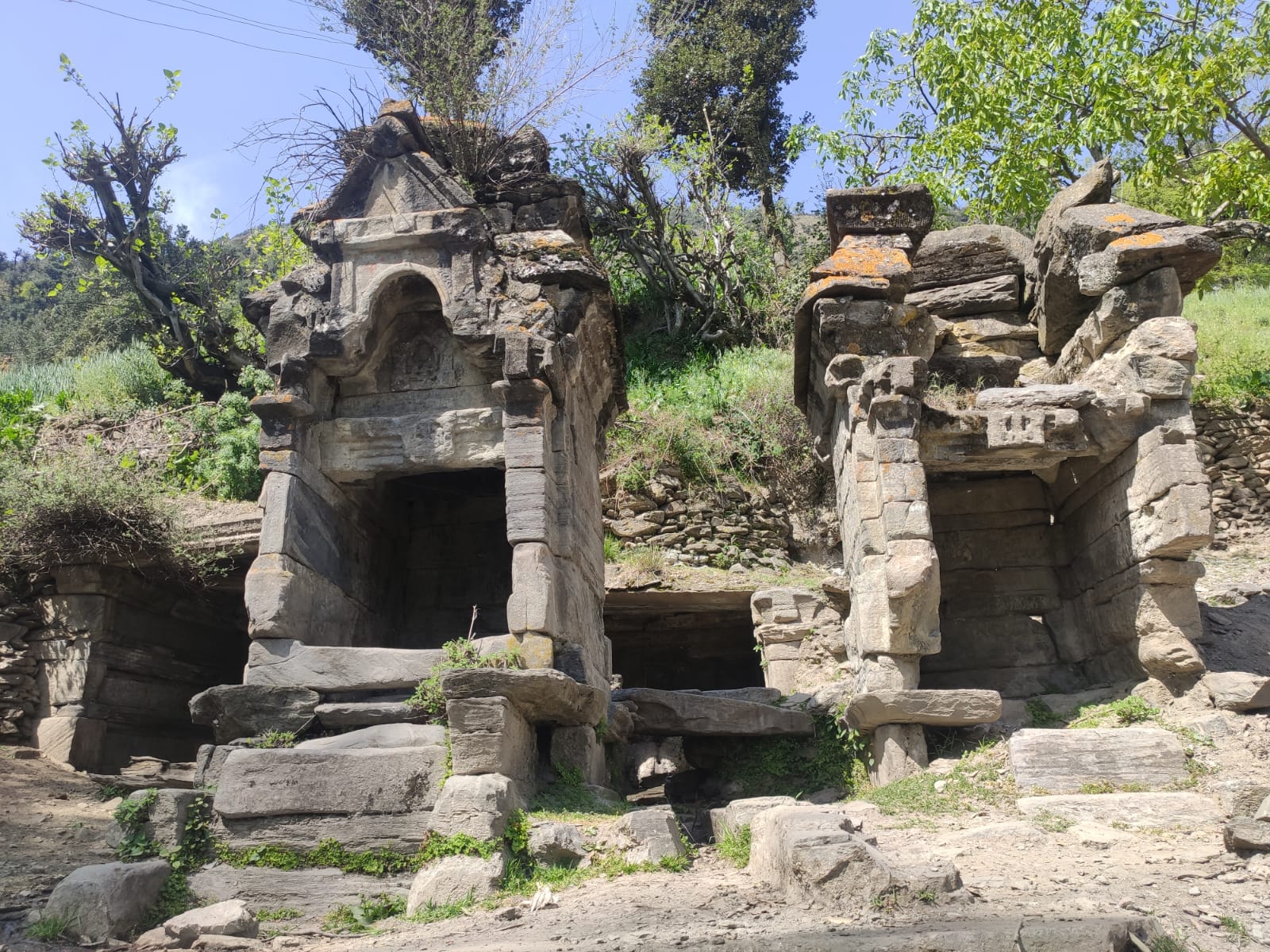
The Cherji temples feature a rare twin-shrine plan: two independent garbhagrihas (sanctums) erected side by side. This configuration suggests dedications to complementary deities likely Shiva and Shakti, or dual aspects of a single divinity such as Uma-Maheshvara. Twin temples recur in Kashmiri architecture, as at Naran Nag, symbolizing cosmic balance (ardhanarishvara principles) or familial piety. Constructed from locally quarried grey sandstone and granulite, the shrines employ dry masonry precisely dressed blocks interlock without mortar, relying on gravitational stability. Lichen encrustation and erosion patterns confirm their antiquity, with no evidence of later repairs. The left temple survives better, displaying a tri-ratha elevation three vertical projections (ratha) emphasizing the central axis. Its entrance boasts a trefoil arch (a three-lobed doorway) surmounted by a triangular pediment with a recessed niche, once housing a deity image in lalitasana (royal ease) pose, possibly Vishnu or the divine couple Shiva-Parvati. The roof forms a pyramidal sikhara via corbelled courses each layer juts inward progressively, culminating in an amalaka-like cap (now missing). The right temple, more dilapidated with its sikhara collapsed, retains traces of the adhisthana (plinth mouldings), jangha (wall body), and varandika (eave cornice). Its simpler entrance implies a subsidiary role, perhaps an antarala (antechamber) or attendant shrine. Both share a low pitha (platform) with 2–3 steps, absent mandapa (pillared hall), and ekakuta (single-spired) form—hallmarks of pre-900 CE Kashmiri temples. No pradakshina path (circumambulatory) encircles them, underscoring their compact, village-scale design.
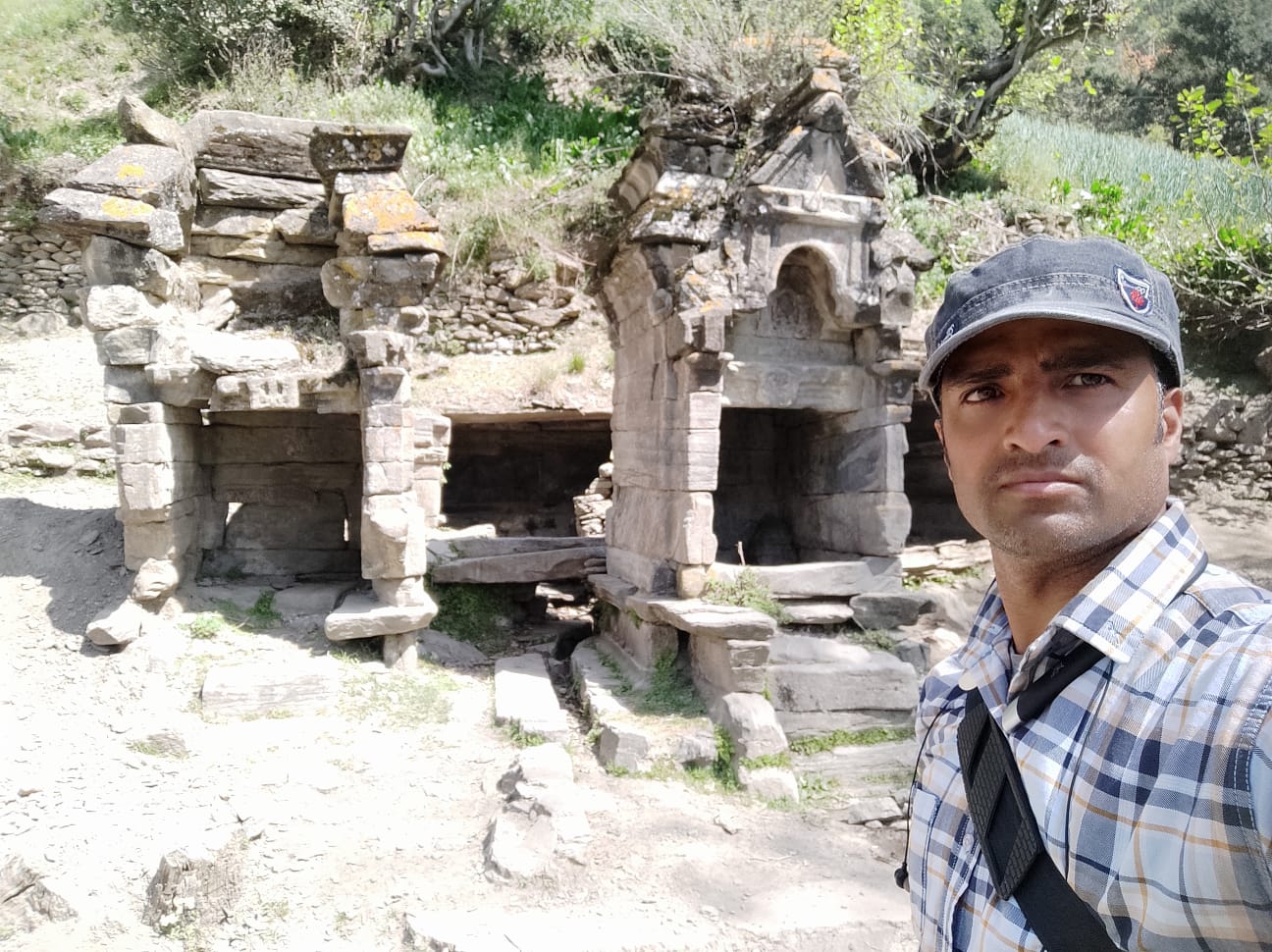
Cherji’s motifs anchor it firmly in Kashmiri Nagara. The trefoil arch, a Kashmiri hallmark from 700–1200 CE, echoes Martand Sun Temple (c. 725 CE), Avantipora (9th century), and Pandrethan (920 CE). This lobed form derives from wooden prototypes, adapted to stone for durability in seismic zones. The triangular pediment above the niche traces to Gandhara’s wooden gables, perpetuated in Kashmiri stonework. Corbelling dominates the sikhara pre-true-arch technique where stones cantilever inward, contrasting later curvilinear towers. Minimal ornamentation—faint mouldings, no figural sculptures—signals an 8th–9th century date, predating the profuse carvings of 11th-century Lohara-era temples like those at Khir Bhawani. Subtle details include kantha (wall offsets) and vedibandha (base bands), aligning with R.C. Kak’s classification of “proto-Nagara” in Ancient Monuments of Kashmir (1933). Weathering has erased potential inscriptions, but stylistic purity suggests Karkota dynasty patronage (625–855 CE).
Cherji and Its Architectural Siblings Cherji temples form part of a “Kashmiri-Kishtwari” style, extending from Srinagar to Bhaderwah. This table compares key peers: This shared “grammar”—trefoil arches, corbelled roofs, compact sanctums—defines the Kashmiri Nagara idiom, as outlined by R.C. Kak and M. A. Stein in Rajatarangini commentaries. Regional gradients emerge: Pandrethan’s aquatic grandeur reflects royal Meru Vardhana’s patronage; Bimalnag Saroor and Sai Draman Nagseni scale down for mid-tier sites; Cherji’s modesty fits Grama-Devata (village deity) shrines. Chronologically, Cherji and Sai Draman’s austerity predates Pandrethan’s embellishments, aligning with Karkota (750–855 CE) or early Utpala (855–1003 CE) phases when Kishtwar lay in Kashmir’s cultural orbit. Further afield, Chamba’s Lakshmi-Narayana Temple (10th century) adopts similar corbelling, hinting at trade-route diffusion via the Pir Panjal passes.
READ MORE: The Lost Monastery of Ahiliya – A Forgotten Himalayan Seat of Buddhist Learning
Ties to Kashmir Kalhana’s Rajatarangini (12th century) names Kishtwar, a semi-autonomous tributary of Kashmir’s kings. Cherji likely emerged during this 600-year continuum, when Shaiva missionaries from Kashmir Valley penetrated Chenab valleys, erecting shrines amid Dardic and Buddhist substrata. Geopolitically, Kishtwar guarded passes to Chamba and Ladakh, explaining temple proliferation as markers of Kashmiri suzerainty. Stein’s surveys noted similar “frontier” sites, underscoring Cherji’s role in proving architectural continuity.
Twin shrines evoke Shaiva-Shakti duality, ubiquitous in Kashmir (e.g., Shankaracharya and Chakreshwari). Alternatives include ancestor smarakas Bhaderwah examples honor local chiefs or monastic pairs a chaitya (stupa-shrine) and Vihara (meditation cell), later Hinduized post-8th century Buddhist decline. Ethnographic parallels persist in Kishtwari folklore, where paired devta shrines host dual festivals. This triad traces a Chenab-axis “artistic corridor,” paralleling the Jhelum Valley’s temple chain. Cherji anchors the Kishtwar segment, linking Sai Draman (Nagseni) and Bimalnag (Saroor) to Valley prototypes.
Kishtwar’s past relies on oral lore and scattered epigraphs, with temples like these bridging Kashmir’s documented grandeur (Martand) and Himachal’s (Chamba). They evidence a decentralized temple economy—state temples in valleys, folk shrines in hills mirroring South India’s Grama Devta tradition. Yet threats loom seismic activity, lichen-induced spalling, and neglect accelerate decay.
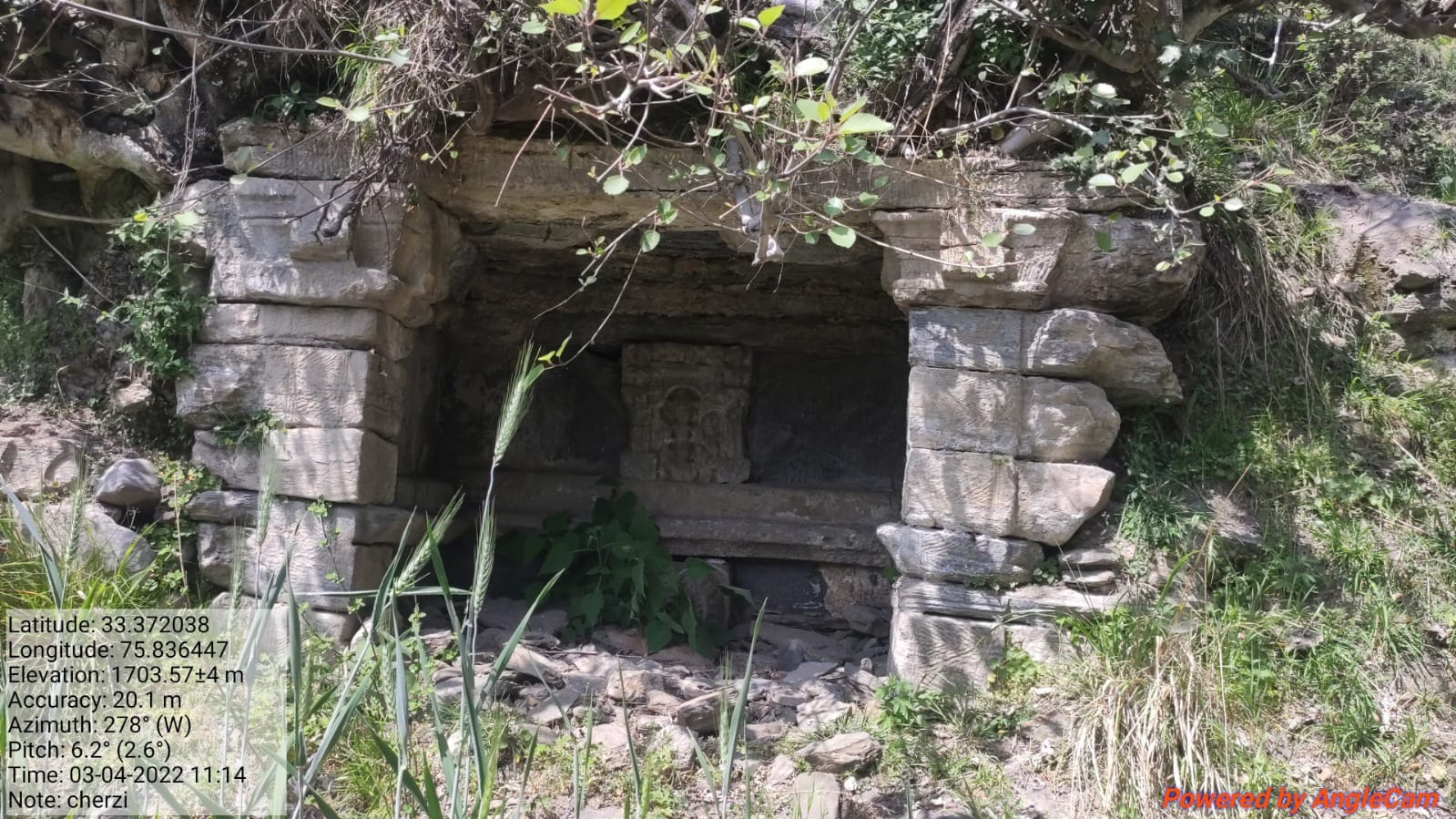
After going a little above the twin temples at a distance of five minutes, one can find a Baolie. The structure is not a deep stepwell but a pranali kunda or devri a shallow, rock-cut cistern with a built stone facade. Corbelled stone slabs form a low ceiling. The overgrowth of vegetation and collapse on the right side indicate the original roof extended further forward. Same grey micaceous sandstone as the twin temples, confirming contemporaneity. Tool marks and block size match the 9th-century masonry of Sai Draman.
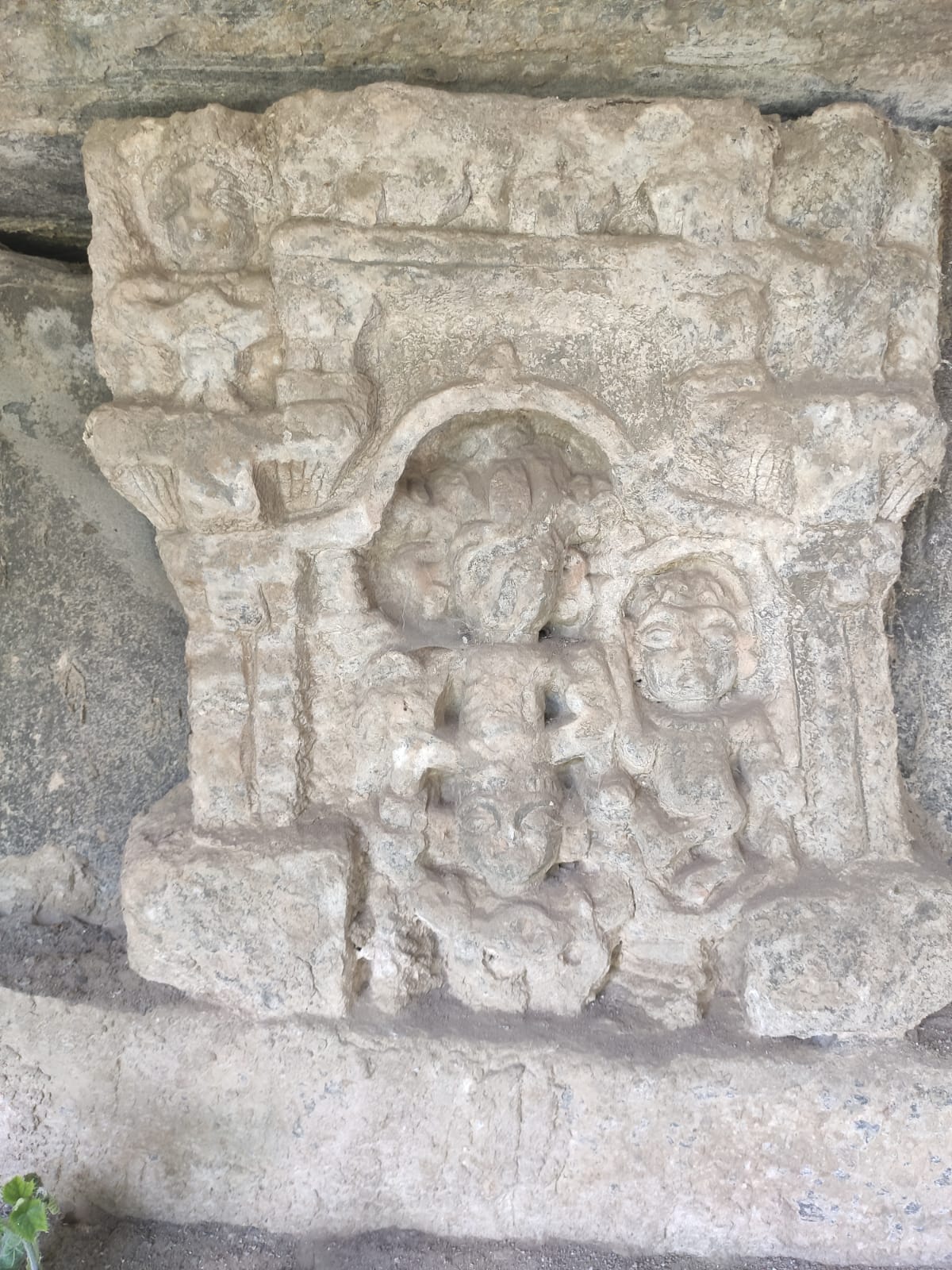
Inside the Baolie, centered on the rear wall, is a carved stone panel. Though weathered, your field identification and the visible composition confirm it as Garudasana Vishnu with Devi Lakshmi. Lord Vishnu ji seated in lalitasana on Garuda.
Conclusion:
The Cherji twin temples are no mere ruins, they are a missing link, affirming Kashmiri Nagara’s reach into Kishtwar by the 9th century. As Kalhana’s Kashthavata endures in stone, these shrines demand scholarly resurrection akin to Martand or Pandrethan. Preserving them safeguards not just architecture, but Kishtwar’s identity as a Himalayan cultural nexus, inviting archaeologists, historians, and administrators to act before erosion claims this irreplaceable heritage.
AUTHOR: Anil Kumar Bhagat (M.A. History, M.A. Sociology, B.Ed., I.T. & E.S.M.)
(Freelancer, Ancient Indian History, Culture and Archaeology)
(Teacher in Education Department of U.T. J&K)
(Email: anilk11111982@gmail.com)
READ MORE: WAZIR-E- WAZARAT: DUNI CHAND MEHTA: BRAVE HEART OF KISHTWAR
Disclaimer:This article presents the author’s personal research and interpretation of historical events. www.mykishtwar.com provides this platform for the dissemination of information and diverse perspectives. The accuracy, completeness, and validity of any statements made within this article are solely the responsibility of the author. The content of this article is the sole responsibility of the author. www.mykishtwar.com does not assume any liability for the information presented. The author’s views and opinions do not necessarily represent those of www.mykishtwar.com. Readers are encouraged to conduct their own research and verify the information presented.