Buddhist Population
Buddhism in Kishtwar Since
Dalai Lama Visit
Congregation at Gulabgarh
Gumpa Architecture Style
Gumpas of Kishtwar
Kishtwar district holds one of the least-known yet most remarkable chapters of Himalayan Buddhist history — a living tradition that stretches from the 2nd century BC to the present day, thriving in the high-altitude valleys of Tehsil Paddar.
Buddhist Population of Kishtwar
Gumpas of Kishtwar
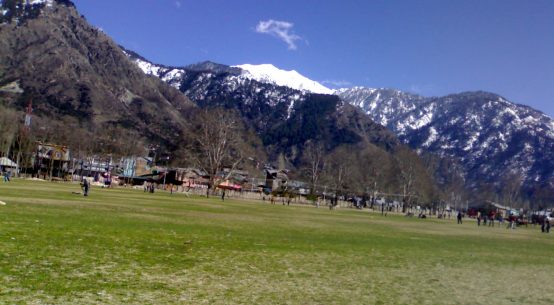
Kishtwar district is home to a significant Buddhist community of approximately 7,000 Buddhists, concentrated in the upper reaches of Tehsil Paddar. These communities live at high altitudes bordering Ladakh on one side and the tribal areas of Pangi and Lahaul-Spiti in Himachal Pradesh on the other — preserving their ancient traditions, customs, and way of life across generations.

A landmark moment came when the Buddhist Centre at Gulabgarh was inaugurated by His Holiness the Dalai Lama on 5–6 June 2010, drawing a remarkable congregation of approximately 25,000 Buddhists from Paddar, Ladakh, and Himachal Pradesh — a powerful affirmation of the living Buddhist identity of the Kishtwar region.
Historic Event — June 2010
Event: Inauguration of Buddhist Centre, Gulabgarh
Inaugurated by: His Holiness the Dalai Lama
Date: 5–6 June 2010
Congregation: ~25,000 Buddhists from Paddar, Ladakh & Himachal Pradesh
Ancient Buddhist History of Kishtwar
According to historians, Buddhism flourished in the Nagseni area of Kishtwar as far back as the 2nd century BC. A significant conference on Buddhism is believed to have been held at Village Bhattan in Nagseni — pointing to the area’s early and important role in the spread of Buddhist thought across the Himalayan region.
Even more remarkably, the great Buddhist scholar Nagsen, famous for the celebrated text Milinda Panho, is believed to have been born in this very region. It is a striking historical irony that today, not a single Buddhist family resides in the Nagseni area — the very birthplace of this ancient tradition — while the faith continues to thrive in the Paddar valleys.
Historical Record — Kishtwar
“The great Buddhist scholar Nagsen of Milinda Panho fame is said to have been born in the Nagseni area of Kishtwar — one of the most remarkable and lesser-known facts about this Himalayan district.”
Buddhist Villages of Paddar — A Living Heritage
The Buddhist communities of Kishtwar are settled across several villages in Paddar Tehsil. The villages of Hango, Haloti, Machail, Lusseni, Dangail, and Suncham in the Machail Valley lie along the border with Ladakh and Kargil, while the villages of Kabban, Tun, and Charkhoni border Himachal Pradesh.
These Buddhist habitations, with their distinctive customs, traditions, and unique way of life, hold immense potential to attract tourists of diverse interests — from cultural explorers and religious pilgrims to adventurers and historians.
Buddhist Villages in Paddar Tehsil, Kishtwar
🏔️ Haloti
🏔️ Machail
🏔️ Lusseni
🏔️ Dangail
🏔️ Suncham
🏔️ Kabban
🏔️ Tun
🏔️ Charkhoni
Entering a Buddhist Village — Symbols & Traditions
Approaching a Buddhist village in Kishtwar is an experience rich in symbolism. On the entry to every Buddhist village stands a stone gate called the ‘Manidwar’. The stone walls leading to the village are adorned with images of Lord Buddha and revered saints such as ‘Wajar Pani’.
White cloth flags known as ‘Darshod’ flutter along the pathways and on rooftops. These flags bear images of Munnies (monks) and sacred inscriptions. Buddhists believe that these flags keep evil spirits at bay and protect their homes — a living visual expression of deep and enduring faith.
🪨 Manidwar
The stone gate at the entry of every Buddhist village — a sacred threshold marking the transition into a space of faith and tradition.
🏳️ Darshod
White prayer flags on rooftops and pathways bearing images of Munnies and sacred edicts — believed to ward off evil spirits and protect Buddhist homes.
☸️ Dharm Chakra
A revolving wheel fitted on Gumpa pillars — devotees rotate it believing it relieves misfortune and brings blessings and relief from ominous circumstances.
The Gumpas — Buddhist Monasteries of Kishtwar
The Buddhist places of worship in Kishtwar are called Gumpas. In Paddar Tehsil, prominent Gumpas are located at Gulabgarh, Haloti, Kabban, and Tun. Typically constructed on a hillock or elevated location, they are visible from the surrounding landscape and resemble a fort from a distance. Most are two or three-storeyed, housing both a worship hall and a residential block for the Lamas.
All Gumpas of Kishtwar have been built in the Ladakhi and Tibetan architectural style, with master artisans from Ladakh and Tibet engaged in their construction. The stonework and wood carving are of exceptional quality — making them among the most visually stunning religious spaces in the Jammu region.
Inside a Gumpa — Art, Idols & Worship
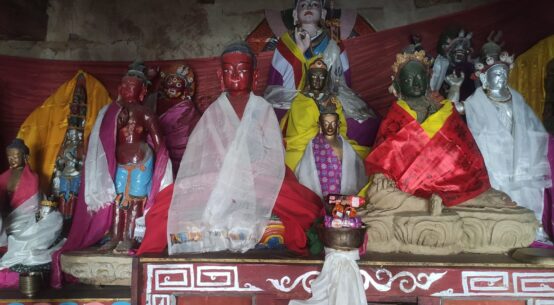
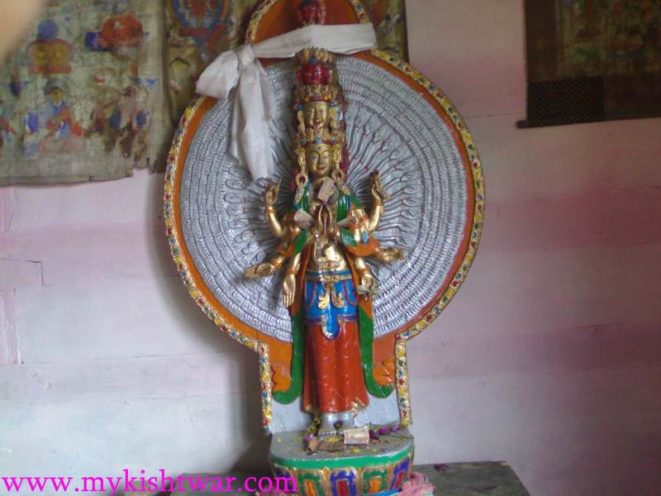
At the centre of each worship space stand large copper idols of Lord Buddha, Shakti Munni, and Siddhacharyas such as Padam Sambhav, Rattan Bhat, and others. The walls are decorated with oil-coloured paintings depicting Lord Buddha, Shakti Munni, and Goddesses including Tara, Gandhari, and Saraswati.
The colourful engravings of Lord Buddha, Acharyas, Munnies, and Goddesses throughout the Gumpa are superb and eye-captivating — a breathtaking fusion of centuries-old devotion and Himalayan artistry.
Worship, Rituals & The Role of the Lama
Prayers are led by the Lama before the large idols, accompanied by the rhythmic beating of drums and the lighting of oil lamps in small silver cups. The Lama performs all religious ceremonies for the villagers, serves as their teacher and guide, and acts as an arbitrator in all village affairs.
Every Buddhist family offers cooked food first to the Gumpa before consuming it themselves — a daily act of devotion and communal bond. The Buddhist families of Paddar bear all the expenses of their Lamas, ensuring the continuity of this ancient tradition in the high Himalayas of Kishtwar.
The Lama — An Embodiment of Buddhist Virtues
The Lama’s life is one of complete devotion — absorbed in meditation, recitation of mantras, telling his beads, and study of scriptures.
He embodies the highest Buddhist virtues: truthfulness, simplicity, honesty, piety, frankness, and an elevated degree of spirituality — revered as the spiritual, social, and moral heart of his village community.
💡 Did you know? The great Buddhist scholar Nagsen of Milinda Panho fame is believed to have been born in the Nagseni area of Kishtwar — making this Himalayan district an ancient cradle of Buddhist scholarship. Yet today, not a single Buddhist family lives in Nagseni, while the tradition flourishes in the Paddar valleys just kilometres away.
🙏 Namo Buddhaya · Buddhist Heritage of Kishtwar 🙏
Related Topics
Buddhist Heritage Paddar
Gumpa Kishtwar
Dalai Lama Gulabgarh 2010
Nagsen Milinda Panho
Tehsil Paddar Kishtwar
Buddhist Villages Machail Valley
Manidwar Buddhist Gate
Darshod Prayer Flags
Ladakhi Architecture Kishtwar
Nagseni Buddhism 2nd Century BC
mykishtwar.com
Heritage & Culture Series |
mykishtwar.com
· Kishtwar, Jammu & Kashmir, India