🏅
Official Recognition
Saffron has been awarded the prestigious Geographical Indication (GI) Tag by the Geographical Indications Registry of India — recognising its distinctive identity, exceptional quality, and unique geographical origin.
Kung (Kishtwari)
Kesar (Hindi/National)
Zafran (Persian)
Kum-Kum / Lohit (Sanskrit)
Kung Posh (Kashmiri)
Kishtwar — The Land of Saffron
Saffron is the costliest and most prized crop of Kishtwar — the golden thread that has defined the district’s identity, economy, and culture for millennia. Kishtwar’s very ancient name, Lohit Mandal (meaning “Land of Saffron”), mentioned in the 27th chapter of Sabha Parva in the Mahabharata Part I, tells us that saffron cultivation here predates recorded history.
The botanical name of saffron is Crocus sativus — a name suggesting it was first cultivated in ancient Croycus (now Kolghos in Syria). Today it is produced in Spain, Iran, France, Sicily, and Jammu & Kashmir. But in India, Kishtwar is the only saffron-producing district in the entire Jammu province, making it irreplaceable in the country’s agricultural heritage.
Most remarkably: the quality of Kishtwar Saffron is superior to that of Pampore in Kashmir — the world’s most famous saffron-growing region. Kishtwar’s higher altitude (approximately 5,351 feet), mineral-rich soil, dry cultivation technique, and the meticulous skill of its farmers produce saffron threads of unmatched colour, aroma, and potency.
Hectares Cultivated
Annual Production
Cultivation Altitude
Official Recognition
Era of Origin
Medicinal, Culinary & Cultural Uses
Kishtwar Saffron is far more than a cooking spice. Its colour and aroma are considered auspicious across India. Its taste is subtle — but if even a little is chewed directly, it turns pleasantly bitter. Two or three stigmas (carpels) crushed and mixed in warm milk create a powerful health tonic. Saffron is:
😴 Sedative
🩺 Curative
🧠 Exhilarant
🍳 Culinary Spice
🙏 Religious Tilak
🌡️ High in Crocin
🛡️ Immunity Booster
In Hindu tradition across India, saffron is used for applying the sacred Tilak (mark on the forehead) — a practice directly tied to Kishtwar’s Kesar fields. It is also used in medicines, in the cooking of vegetables and rice dishes, and in the preparation of the famous Kahwah Chai and Kashmiri Pulao of the region. Kishtwar saffron is high in crocin — the compound responsible for its intense deep-red colour and distinctive aroma — making it a globally recognised premium variety.
Saffron-Growing Villages of Kishtwar (Mandal Area)
Out of the 156 revenue villages of Kishtwar district, saffron is cultivated in a select cluster of villages in the area known as Mandal — the ancient saffron heartland that gave Kishtwar its Mahabharata-era name Lohit Mandal. The total cultivated area is approximately 120 hectares, producing an average of 5 quintals of saffron annually.
| Village | Area (Hectares) | Village | Area (Hectares) |
|---|---|---|---|
| Poochhal | 74.50 | Matta | 03.20 |
| Sangram Bhatta | 01.00 | Hidyal | 06.50 |
| Cheerhar | 01.45 | Hudri | 02.15 |
| Dugga | 00.50 | Draba | 01.05 |
| Berwar | 01.50 | Archi | 01.35 |
| Hullar | 02.00 | Tund | 03.50 |
| Hatta | 01.75 | Lanyal | 00.65 |
| Sarkoot | 00.10 | Malipath | 01.00 |
| Bera-Bhatta | 10.75 | Bindraban | 01.00 |
| Begana | 06.05 | ||
| TOTAL | 120 Hectares | Source: District Saffron Officer, Kishtwar | |
Scientific Classification
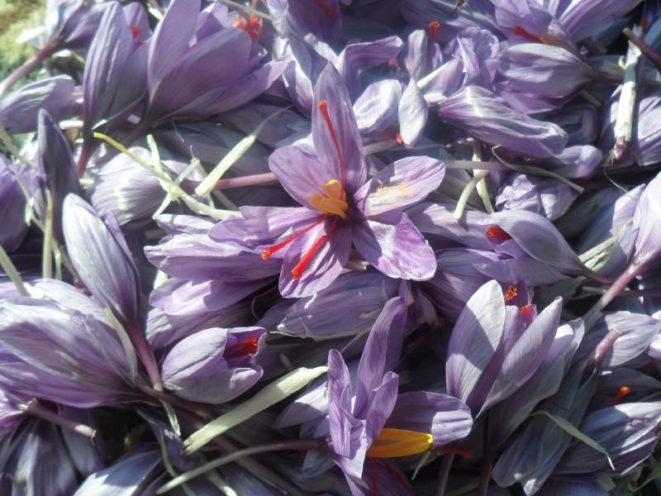
Saffron belongs to the family Iridaceae of the order Asparagales. It is a small perennial plant with grey-green leaves that have hairy margins and grow to about 1–1.5 feet long. Around August or September, the corm produces a funnel-shaped reddish-purple flower (sometimes lilac or white). The flowers are hermaphrodite and pollinated by bees and butterflies. Each flower carries three red stigmas — which, once dried, become the saffron threads known as Kung in Kishtwar and Kung Posh in Kashmir.
| Classification | Name |
|---|---|
| Kingdom | Plantae |
| Division | Magnoliophyta |
| Class | Liliopsida |
| Order | Asparagales |
| Family | Iridaceae |
| Genus | Crocus |
| Species | Crocus sativus |
The Saffron Production Process — Step by Step
Saffron cultivation in Kishtwar is an intensely labour-intensive process requiring generational skill and patience. Each step below is critical to the final quality of the Kung:
Kishtwar Saffron vs the World
While saffron is produced globally in Spain, Iran, France, Sicily, Morocco, and Kashmir’s Pampore, Kishtwar saffron stands apart. Its superiority comes from a unique combination of factors:
◆
Altitude: Grown at ~5,351 feet above sea level — the Kishtwar Plateau’s unique elevation creates ideal cool, dry conditions.
◆
Mineral-rich soil: The Himalayan geology of the Mandal area provides soil uniquely suited to producing high-crocin saffron threads.
◆
Dry technique: Unlike the irrigated fields of Pampore, Kishtwar saffron grows under purely rainfed, natural conditions — enhancing concentration and aroma.
◆
Traditional handpicking: Every thread is hand-harvested before sunrise using centuries-old techniques, ensuring maximum potency and purity.
◆
GI Tag recognition: India’s Geographical Indications Registry has officially recognised Kishtwar Saffron’s unique identity and quality — a global stamp of authenticity.
Heritage Significance
“The cultivation of saffron in Kishtwar dates back to the Mahabharata period — the reference to Lohit Mandal in the 27th chapter of Sabha Parva is one of the earliest recorded mentions of saffron cultivation anywhere on earth.”
— Historical record, mykishtwar.com
💡 Did you know? The crocus plant has no seeds — it is cultivated and multiplied only through its bulbs (corms). This means every saffron field in Kishtwar has been sustained for generations through careful manual propagation — a living agricultural heritage passed from parent to child across thousands of years. In Kishtwar, the saffron thread is locally called Kung Pouh (in Kishtwari) and Kung Posh (in Kashmiri) — the “saffron flower” — a name used since time immemorial.
Related Topics
Kesar Kishtwar
Kung Kishtwar
Crocus sativus J&K
GI Tag Saffron India
Lohit Mandal
Saffron Cultivation India
Mandal Kishtwar
Pochhal Village Saffron
Saffron vs Pampore
Kishtwar Agriculture
mykishtwar.com
Source: District Saffron Officer, Kishtwar | Agriculture Department, Kishtwar |
mykishtwar.com
· Kishtwar, Jammu & Kashmir, India
Very glad to read your blog.Thank you for sharing this article.It is great! I will keep your article in my idea. Very happy reading.
Equinox Oxygen Concentrator
Thank You Sir