Tato Jaya”
there is Victory
Vasundhara”
by the Brave
Bahudha Vadanti”
call it by many names
Karma · Yoga
of Wisdom for the World
“Dharma is the very breath of Bharata — without it, Bharat would cease to exist. As long as this soul remains alive and vibrant, Bharat will continue to inspire, uplift, and illuminate not only its own people but the entire world.”
— Anil Kumar Bhagat
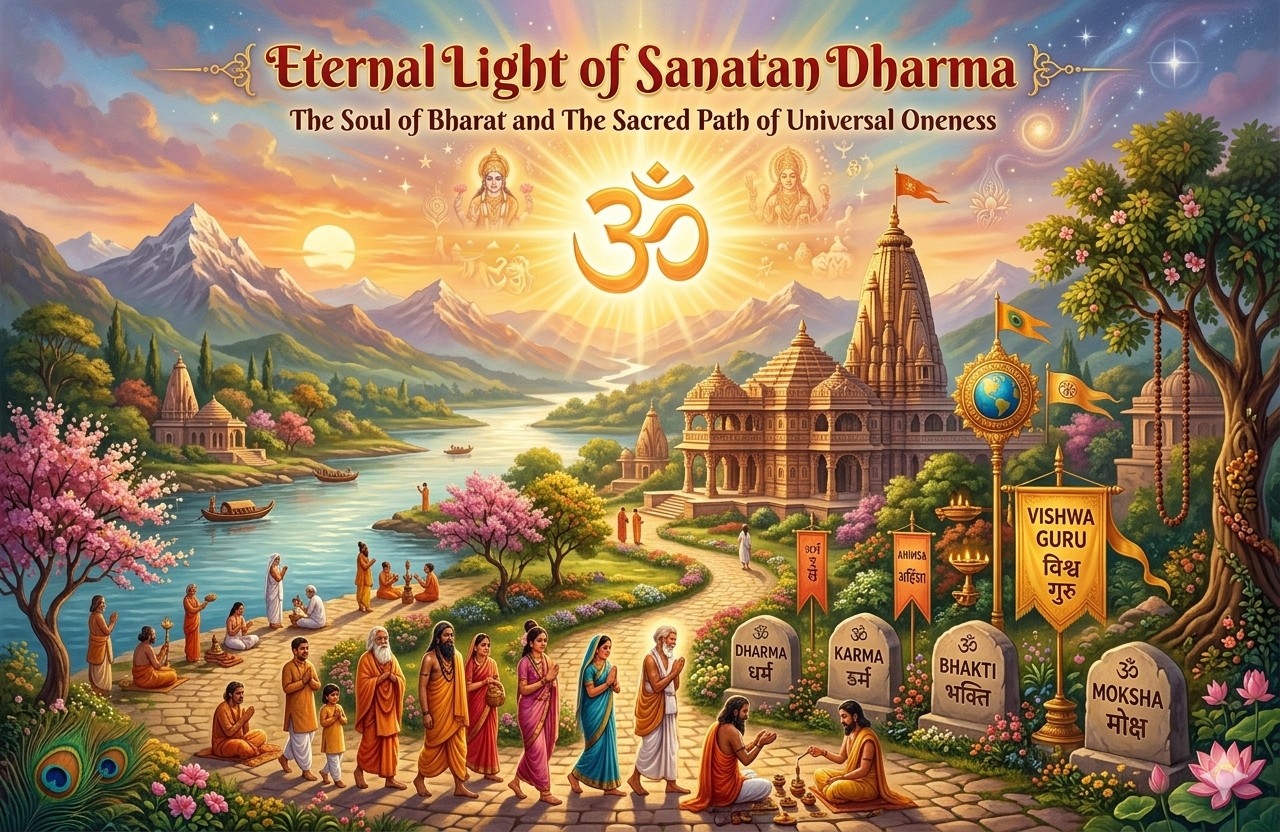
Eternal Light Of Sanatan Dharma
The Unextinguished Flame — Sanatan Dharma Through the Ages
In the vast expanse of Bhartiya history and culture, Dharma has always stood as the unshakeable foundation of society. Even when other ancient civilizations saw their spiritual and moral traditions fade or disappear, the eternal flame of Sanatan Dharma in Bharata has never been extinguished. Its philosophical streams, commentaries, epics, Puranas, and interpretive texts have flowed continuously like a mighty river, nourishing every aspect of life.
The pure, unadulterated wisdom of Bhagwan Shri Krishna, as revealed in the sacred Bhagavad Gita and other scriptures, has been preserved and transmitted through generations of sages and scholars. This living tradition of inquiry, contemplation, and realization continues to illuminate the path for humanity. The divine knowledge bestowed by the Lord ensures that this wisdom remains accessible, making its complete disappearance from human society impossible.
The center of Sanatan life is Dharma. Every sphere of existence in Bhartiya civilization is governed and sanctified by it. Whether in matters of personal conduct, economic systems, political principles, social organization, or the rights and duties of individuals — Dharma provides the guiding light for education, health, agriculture, industry, arts, and sciences. The profound analysis of Dharma in Bhartiya scriptures encompasses not only philosophy and religion but also science, literature, and history.
🔱 What Is Sanatan Dharma?
Sanatan Dharma is not merely a set of rituals or beliefs confined to one era — it is a timeless, universal framework for righteous living that transcends time and space. Its scriptures do not promote blind faith but encourage deep inquiry, logical reasoning, and personal realization.
The Vedas, Upanishads, Puranas, and Itihasas collectively form a comprehensive guide that addresses every dimension of human existence — from the mundane to the metaphysical. Its inclusiveness recognizes the diversity of human temperaments and provides multiple paths for individuals to follow their own inner calling.
The Eternal Relevance of Sanatan Dharma
Eternal Light of Sanatan Dharma: One of the greatest strengths of Sanatan Dharma is its inclusive nature. It recognizes the diversity of human temperaments and provides multiple paths — Jnana (knowledge), Bhakti (devotion), Karma (action), and Yoga — allowing individuals to choose what resonates with their inner calling. This flexibility has enabled it to survive countless invasions, social upheavals, and ideological challenges.
In today’s world, where material progress often overshadows spiritual values, the message of Sanatan Dharma offers a much-needed corrective. It teaches that true progress is not measured solely by technological advancement or economic growth, but by the harmonious development of body, mind, and soul. It emphasizes duties (kartavya) over mere rights, inner discipline over external regulation, and long-term welfare over short-term gains.
The family system in traditional Bhartiya society was built on Dharmic principles — respect for elders, commitment to relationships, and shared responsibilities. The educational system aimed at character building alongside knowledge acquisition. Governance was expected to uphold Dharma rather than personal or partisan interests. Even economic activities were regulated by ethical considerations to prevent exploitation and ensure fairness.
📖
Jnana
The Path of Knowledge — deep inquiry and philosophical realization
🙏
Bhakti
The Path of Devotion — surrender and love toward the Divine
⚡
Karma
The Path of Action — righteous deeds performed without attachment
🧘
Yoga
The Path of Union — disciplining the body and mind toward liberation
The Unbreakable Spirit of Bhartiya Civilization
The Bhartiya people have demonstrated an extraordinary capacity to preserve their unique identity. Even while engaging with diverse communities across the world and studying their historical rise and fall, Bhartiyas have never compromised their core values or surrendered their spiritual independence. This unwavering commitment to their own Dharmic foundation has always guided them toward building a life centred on eternal principles.
The mantra “Veer Bhogya Vasundhara” — The Earth is enjoyed by the brave — reflects the fearless spirit with which various communities in Bharata asserted their rights and shared in the prosperity of the nation. They participated fully in governance and enjoyed its fruits. Ancient Bhartiya Puranas have meticulously documented the historical cycles of rise and fall of rulers and demons, clearly illustrating the profound significance of this eternal mantra.
The divine vision of Bhagwan Shri Krishna — “Yato Dharmas Tato Jaya” (Where there is Dharma, there is victory) — serves as the eternal blueprint for national glory and immortality. Dharma ensures that life remains vibrant, graceful, and resilient through every challenge. Though temporary darkness may descend, ultimate victory always belongs to those rooted in righteousness.
🕉️ The Eternal Blueprint
“Yato Dharmas Tato Jaya”
Where there is Dharma, there is Victory.
— Bhagwan Shri Krishna, as enshrined in Bhartiya wisdom tradition
Sanatan Dharma and Community Faiths
At its root, Bhartiya Dharma is not sectarian or limited to any particular group. It is the universal mother of all spiritual paths. Sanatan Dharma does not reject community-specific faiths — rather, it nurtures and honours them within its vast embrace. It recognizes that human society is diverse in temperament, intellect, and nature, and that not everyone requires the same path, belief system, or set of practices.
Sanatan Dharma has always respected and nourished various community traditions. It provides space for different philosophies, rituals, and lifestyles without imposing uniformity. This generous accommodation has prevented rigidity and allowed organic growth. Sanatan Dharma never obstructs personal freedom in matters of faith — it offers complete liberty to every man and woman to follow their chosen path of devotion, knowledge, or action, while remaining within the broader framework of eternal principles.
From the beginning of time, various community faiths have emerged within this grand ecosystem of Sanatan Dharma. They have grown, sometimes faced challenges, and even attained temporary independence. Yet none have ever been able to sever their connection from the eternal source. Sanatan Dharma remains their nurturing womb and guiding light. Even when certain traditions appeared to drift or establish separate identities, they ultimately drew strength from the same ancient reservoir.
ℹ️ The Inclusive Nature of Sanatan Dharma
Sanatan Dharma accommodates countless viewpoints, methodologies, and traditions. It creates a harmonious environment where diversity flourishes without conflict. In its infinite wisdom, it integrates diverse streams of thought while preserving its own luminous core — offering space for different philosophies, rituals, and lifestyles, never imposing uniformity. Occasional differences in community practices highlight certain aspects, but they always enrich rather than diminish the universal Dharma.
The Resilience of Dharmic Traditions
History bears witness to how Sanatan Dharma has absorbed, refined, and elevated various streams of thought. It has never been threatened by diversity — instead, it has used diversity as a source of strength. Different communities have contributed their unique insights, rituals, and experiences, which have been woven into the rich tapestry of Bhartiya civilization.
While other ancient civilizations often became rigid or fragmented under pressure, the eternal tradition of Bharata adapted without losing its essence. It provided refuge to seekers from all backgrounds, offering paths suited to different stages of spiritual evolution. Today’s world is marked by ideological conflicts, cultural clashes, and spiritual confusion. Sanatan Dharma’s model shows that unity does not require uniformity — societies can maintain harmony while celebrating diversity when grounded in universal ethical and spiritual principles.
Dharma has been the invisible force binding Bharata’s diverse population. It shaped social norms, legal frameworks, educational ideals, and economic ethics. The concept of Rta (cosmic order) and Dharma (righteous duty) ensured that individual actions contributed to collective well-being. Kings were expected to rule as Raja Dharma — prioritizing justice and protection of the weak. Education aimed at self-realization rather than mere information. Family and community life revolved around shared responsibilities and mutual respect.
Even during foreign invasions and colonial domination, Dharmic values provided inner strength. Reformers and saints continuously revived these principles, inspiring movements for independence and cultural renaissance. Figures who embodied Dharma through wisdom, courage, and compassion became beacons for the nation.
🏛️ Dharma in Every Sphere of Bhartiya Life
⚖️ Governance
Raja Dharma — rulers expected to uphold justice and protect the weak above all personal interest
🎓 Education
Aimed at self-realization and character building alongside knowledge — not mere information transfer
🌾 Economy
Yajna (selfless offering) — economic activities regulated to prevent exploitation and ensure fairness
🏡 Family
Built on Dharmic principles — respect for elders, commitment to relationships, shared responsibilities
Universal Message for Humanity
The teachings of Sanatan Dharma extend far beyond Bharata’s borders. Concepts such as the interconnectedness of all life, the law of karma, the pursuit of Moksha (liberation), and the practice of Ahimsa (non-violence) offer profound solutions to global problems. In an age of environmental crisis, the idea of the Earth as a Sacred Mother (Bhu Devi) encourages responsible stewardship. In a polarized world, the emphasis on inner peace and tolerance fosters dialogue.
Sanatan Dharma does not claim exclusivity. It welcomes sincere seekers from all backgrounds. Its scriptures encourage critical inquiry alongside faith, making it compatible with scientific temper. The Upanishadic declaration captures this pluralistic spirit with extraordinary beauty.
📜 Upanishadic Declaration
“Ekam Sat Vipra Bahudha Vadanti”
Truth is One — the wise call it by many names.
As Bharata marches toward greater prosperity and global influence, it must remain anchored in its Dharmic roots. A resurgent Bharat that proudly embraces Sanatan Dharma will not only secure its own future but also offer a civilizational alternative based on harmony, sustainability, and holistic development. The eternal flame of Dharma, kindled by ancient Rishis, continues to guide humanity — calling upon every generation to uphold truth, perform duty, and seek higher knowledge.
By integrating these timeless principles into daily life, governance, education, and culture, Bharata can fulfil its destiny as Vishwa Guru — a beacon of wisdom for the world. The journey of Sanatan Dharma is the journey of Bharata itself — resilient, inclusive, profound, and ever-relevant.
Sanatan Dharma — The Dharma of the Universe and the Human Soul
Sanatan Dharma stands as one of the most generous, profound, and life-affirming traditions known to humanity. Its inclusiveness is so vast that it finds no fundamental conflict with any genuine community faith or spiritual path. On the contrary, various community traditions find their natural place and fuller expression within the grand framework of Sanatan Dharma.
At its heart, Sanatan Dharma is the Dharma of the universe and of the human soul. It grants every individual the sacred right to spiritual inquiry and realization. The very nature of the human soul finds its complete reflection in the cosmic order, and Sanatan Dharma is firmly established upon this unity between the individual self and the universal reality. It illuminates multiple pathways through which the soul can progress, manifesting in countless beautiful and diverse forms.
Wherever Dharma is established as the central pillar, the true essence and glory of Bharata shine forth. As long as the dignity and primacy of Dharma are upheld in human society, all forms of darkness and ignorance will continue to be dispelled from this sacred land. The resilience of the Bhartiya people lies in their deep-rooted connection to Dharma. Even during periods of apparent decline, they have repeatedly risen to re-establish their eternal glory.
🌟 The Path Forward — Dharmic Living in the Modern Age
The solution lies not in rejecting the past wholesale, nor in blind imitation of the West, but in a thoughtful integration — drawing strength from timeless wisdom while embracing beneficial innovations.
Education
Must incorporate Dharmic values — teaching moral and spiritual intelligence alongside professional skills
Technology
Should serve human welfare, not replace human values — guided by the principle of Yajna
Environment
Earth as Sacred Mother (Bhu Devi) — responsible stewardship rooted in the cosmic interconnectedness of all life
Policy
Must promote social harmony by recognising Bharata’s pluralistic yet unified civilizational identity
Related Topics
Bhagavad Gita
Bhartiya Civilization
Vedas & Upanishads
Yato Dharmas Tato Jaya
Karma & Moksha
Ahimsa
Raja Dharma
Vishwa Guru
Yajna
Bhakti & Jnana
Ekam Sat Vipra Bahudha Vadanti
Disclaimer:
This article presents the author’s personal research and interpretation of historical events. www.mykishtwar.com provides this platform for the dissemination of information and diverse perspectives. The accuracy, completeness, and validity of any statements made within this article are solely the responsibility of the author. The content of this article is the sole responsibility of the author. www.mykishtwar.com does not assume any liability for the information presented. The author’s views and opinions do not necessarily represent those of www.mykishtwar.com. Readers are encouraged to conduct their own research and verify the information presented..
About the Author
Anil Kumar Bhagat
anilk11111982@gmail.com | +91-7051350159
Published on mykishtwar.com — Documenting the Heritage & Culture of Kishtwar since 2011