Altitude ASL
Sq. Km Area
Years of History
Historical Names
From Jammu
Nestled in the lap of the Himalayas, Kishtwar is a hidden gem in Jammu & Kashmir — a land where the perfume of saffron mingles with mountain air, where sapphires shimmer in high-altitude streams, and where centuries-old shrines of every faith stand side by side in timeless harmony. Jammu and Kashmir is hailed as the crown of India — and within it, Kishtwar is its most precious jewel.
History of Kishtwar : The Many Names of Kishtwar — A Historical Journey
The existence of Kishtwar town and the area known as Mandal goes back to the time of the Mahabharata — when the region was called Lohit Mandal, meaning “the place of Saffron.” Although ‘Lohit’ has ceased to be used today, the word ‘Mandal’ still exists — it is the name of the villages in the vicinity of the town, and the area around Kishtwar where saffron is cultivated is still called “Mandal” to this day.
According to historians, (History of Kishtwar) was previously called Kashyapwas — meaning “the place of Kashyap Rishi.” It was this great sage who, on the basis of his spiritual powers, got the water of the ancient lake known as Goverdhan Sar drained off — making the land habitable. The theory that Kishtwar was once a lake is confirmed by the fact that the area between the TRC and village Sangrambhata is still called Gudhansar — Sar in Sanskrit meaning ‘Lake.’
With the passage of time, the name Kashtwarak also came to be used. The modern name “Kishtwar” is considered the Prakrit version of the Sanskritised names Kashtwarak and Kashtnivarak — symbolising a place that relieves distress.
📜 Historical Names of Kishtwar Through the Ages
Lohit Mandal — Mahabharata era · “The Place of Saffron” · still survives as ‘Mandal’ village area
Kashyapwas — “The Place of Kashyap Rishi” · named after the great sage who drained Goverdhan Sar lake
Goverdhansar — the ancient sacred lake · still remembered in the name Gudhansar (TRC to Sangrambhata)
Mahakali Garh · Samarth Garh · Bhot Nagar — highlighting sacred, geographical, and regional roots
Kashtwarak / Kashtnivarak — Sanskrit names · Kishtwar is the Prakrit version · meaning “a place that relieves distress”
Kishtwar — Identity, Geography & Scale
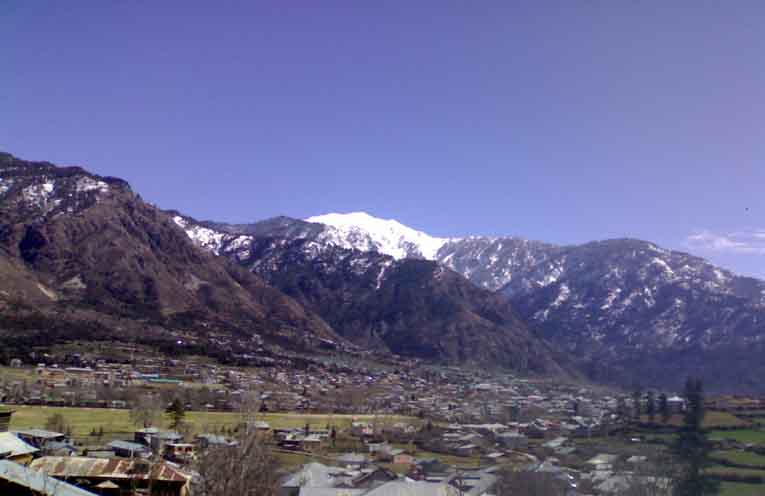
Kishtwar is popularly known as the “Land of Sapphire and Saffron” — a Himalayan district that stands at an altitude of approximately 1,700 metres above sea level, surrounded by mountains, dense forests, and gloriously sloppy hills that give it an amazing and fascinating look. It has earned a proud place on the tourist map of India.
Kishtwar served as the capital of the Erstwhile Kishtwar State until 1821 AD — when Maharaja Gulab Singh, the Dogra ruler of Jammu, annexed it into his expanding dominion. District Kishtwar was later carved out from the erstwhile District Doda during 2007–08, when Chief Minister G.N. Azad took a historic decision in July 2006 for the creation of the new district. It has the unique distinction of being one of the biggest districts in the union territory — just next to Leh and Kargil.
With an area of approximately 7,737 sq. km — almost entirely mountainous like Himachal Pradesh or the Ladakh region — Kishtwar’s area is almost one-half of the combined total area of all eleven districts of the Kashmir Valley, and one-third of the area of the entire Jammu region. Its population of over 2.5 lakh is a testament to the resilience of mountain communities. Habitation is found even at altitudes of 9,500 feet.
📍 Kishtwar — At a Glance
📐 Area: 7,737 sq. km
👥 Pop: ~2.5 lakh
🛣️ 216 km from Jammu
🏛️ 11 Tehsils · 13 Blocks
🛤️ NH 244 (former NH-1B)
🏔️ Highest habitation: 9,500 ft
📅 District formed: 2007–08
Geography & Natural Wonders
Kishtwar is a land of extraordinary geographic contrasts — where dense deodar forests cloak the lower slopes, alpine meadows spread across mid-altitudes, and glaciated peaks soar above 7,000 metres. Connected to the rest of the country through NH 244 (formerly NH-1B) near Batote, it is approached through some of the most stunning mountain scenery in India.
🌿 The Iconic Chowgan Ground — Crown of Kishtwar
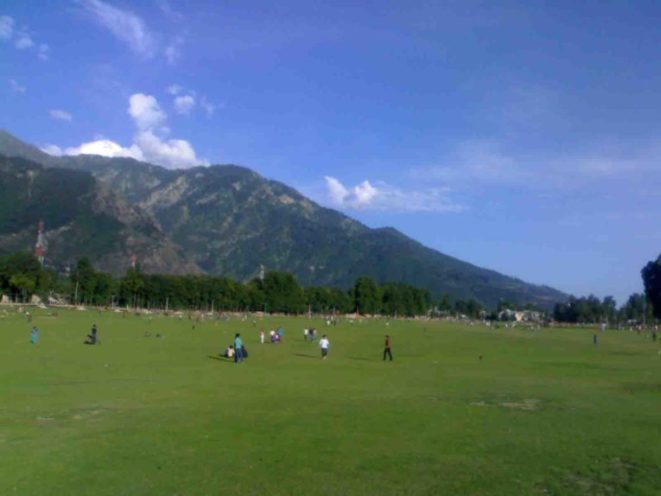
At the very heart of Kishtwar town lies the Chowgan — a magnificent natural ground spanning approximately 520 Kanals (165 acres). Surrounded by majestic Chinar, Deodar, and Pine trees, this spot was once the bed of the ancient Goverdhansar Lake — drained by the spiritual powers of Kashyap Rishi in ancient times. Today, it serves as the cultural, social, and sporting heart of the district — used by all communities for festivals, sports, evening walks, and as a helipad. In winter, snowfall transforms the Chowgan into a pristine skiing and sledging paradise.
🌊 Rivers & Waterfalls
The mighty Chander Bhaga (Chenab) River — one of India’s most powerful Himalayan rivers — is so dramatic in its flow through Kishtwar that one becomes astonished to watch its thundering jumps from a distance. With turquoise glacial waters and extraordinary power, the Chenab is also Kishtwar’s most important economic asset, forming the backbone of the district’s hydro-electric potential.
The Potinag Waterfall, located opposite the NaginShero cliff at 4,090 metres above sea level — which remains covered with snow throughout the year — creates a spectacular, almost otherworldly backdrop. This waterfall is one of the most photographed and celebrated natural sights in Kishtwar.
💧 Sacred Springs (Nag) — Sources of Life & Lore
Kishtwar is blessed with a network of sacred springs — called Nag — which have been revered by the communities of the district for centuries, each carrying its own local legend and healing tradition.
💧 Pooti Nag
💧 Kumai Nag
💧 Godresh Nag
💧 Tata Pani Hot Spring (Warwan)
The Economy of Rare Treasures — Saffron & Sapphires
Kishtwar is globally renowned for two of nature’s most precious gifts — gifts that have defined its identity for more than a thousand years and continue to draw the world’s attention to this remarkable Himalayan district.
🌸 Kishtwar Saffron (Kesar)
Kishtwar holds the distinction of being the only saffron-producing land in the entire Jammu province. The district’s Kesar — cultivated mainly in the villages of Pochhal, Hatta, Matta, and Berwar — is famous worldwide for its intense aroma and deep colour, rivalling the finest saffron anywhere in the world. The saffron fields bloom in October–November, turning the fields into a breathtaking purple carpet. In ancient times, the entire Kishtwar region was known as Lohit Mandal — the land of saffron — and the cultivation area around the town is still called “Mandal” today.
💎 Kashmir Blue Sapphire (Neelam)
Discovered in 1881 in the Paddar region of Kishtwar at an altitude of 4,267 metres, the Kashmir Blue Sapphire is widely regarded as the world’s most expensive and coveted gemstone. These sapphires from Paddar are among the rarest and most exceptional on earth — known for their velvety blue colour and extraordinary clarity. The region is also rich in Quartz crystals and precious Ruby Gems found in the mountainous areas.
Culture, People & Communal Harmony
Kishtwar is a melting pot of diverse ethnicities, races, languages, and religions. Hindus, Muslims, and Sikhs have lived here with amity and brotherhood for centuries — creating a vibrant cultural tapestry that is the district’s most celebrated human quality. The local culture is deeply rooted in hospitality and spiritual traditions, evidenced by the numerous shrines, temples, ziarats, and sacred monuments scattered across the mountains.
The Chowgan itself is the living symbol of this harmony — where Eid prayers, Hindu Dussehra and Baisakhi celebrations, and Sikh festivals are all observed on the same ground. This spirit of shared community space and mutual respect is what kept Kishtwar’s peace unbroken even during the communal violence of the Partition in 1947.
🕌 Holy Places & Sacred Traditions of Kishtwar
🛕 Sarthal Mata Temple — 18-armed goddess temple · one of the most revered Hindu shrines in J&K
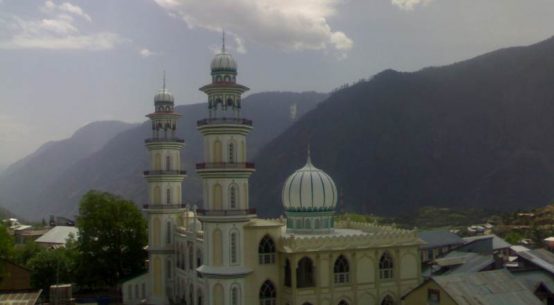
🕌 Jamia Masjid Kishtwar — the grand mosque rebuilt after the 2001 fire · a symbol of community resilience
🙏 Machail Mata Temple — annual yatra draws lakhs of pilgrims to Paddar every summer
🕌 Astaan of Shah Zain-ud-Din (Bhandarkoot) — revered Sufi shrine where Hindus and Muslims offer worship together
🙏 Gori Shanker Mandir — prominent Hindu temple at the north edge of Chowgan, the cultural heart of town
Tourism — A Paradise Waiting to Be Discovered
Kishtwar is full of hidden charm, wonderful sites and spots, health resorts, trekking trails, famous historical and religious places, sacred shrines, and natural monuments. The whole region has fabulous potential for the tourism industry — potential that has been neglected for decades and is now beginning to be realised. While mainstream hill stations struggle with overcrowding, Kishtwar remains a genuinely offbeat destination — perfect for travellers seeking raw, authentic Himalayan experiences.
🏔️ Adventure
Trekking, mountaineering (Nun-Kun 7,135m), paragliding, river rafting on the Chenab, rock climbing, and winter skiing across seven extraordinary valleys.
🦁 Wildlife
Kishtwar National Park — Jammu’s only National Park — 2,191 sq. km of alpine wilderness home to the snow leopard, Hangul (Kashmir Stag), and brown bear.
🌸 Saffron Safari
Visit the purple saffron fields of Pochhal, Hatta, and Matta in October–November — one of the most unique and beautiful natural spectacles in all of India.
🏔️ Sinthan Top
The spectacular 12,500 ft (3,784m) mountain pass connecting Kishtwar to Kashmir Valley via NH 244 — one of India’s most scenic and accessible Himalayan passes.
💎 Sapphire Mines
The world-famous Kashmir Blue Sapphire is mined at Paddar at 4,267m — the source of the world’s most coveted gemstone. Also: ruby gems and quartz crystals.
🌿 Valleys
Dachhan, Marwah, Warwan, Paddar, and Chatroo valleys are among India’s last truly untouched Himalayan wilderness areas — beckoning the world’s adventurers.
How to Reach Kishtwar
Kishtwar is located approximately 216–235 km from Jammu and approximately 280 km from Srinagar. It is well connected via NH 244 (formerly NH-1B) near Batote. JKSRTC buses, private buses, shared taxis, and Sumos operate daily from Jammu to Kishtwar. The journey takes 5–7 hours by road.
✈️ Travel Tips for Kishtwar
Best time to visit: April–June and September–November. For saffron blooms, plan for October–November. For trekking and high passes, visit May–September. Check local weather conditions before travel — the area receives heavy snowfall in winter, and some high roads close from November to April. Nearest airport and railway: Jammu (235 km).
💡 Did you know? Kishtwar was one of the eleven states in Divigrit — now called ‘Dugger’ and then ‘Dugger Desh’ — confirming that it produced saffron even in ancient times. The area under saffron cultivation around Kishtwar town is still called “Mandal” — the remnant of the ancient name Lohit Mandal — a 2,000-year-old tradition of saffron farming that continues to this day.
🌸 Kishtwar — India’s Best-Kept Himalayan Secret 💎
Related Topics
Land of Saffron Sapphire Shrines
Lohit Mandal Ancient Name
Kashyapwas Kashyap Rishi
Kishtwar Jammu Kashmir
Kishtwar Tourism Guide
Kashmir Blue Sapphire Paddar
Potinag Waterfall Kishtwar
Chowgan Kishtwar
mykishtwar.com
History & Heritage Series |
mykishtwar.com
· Kishtwar, Jammu & Kashmir, India