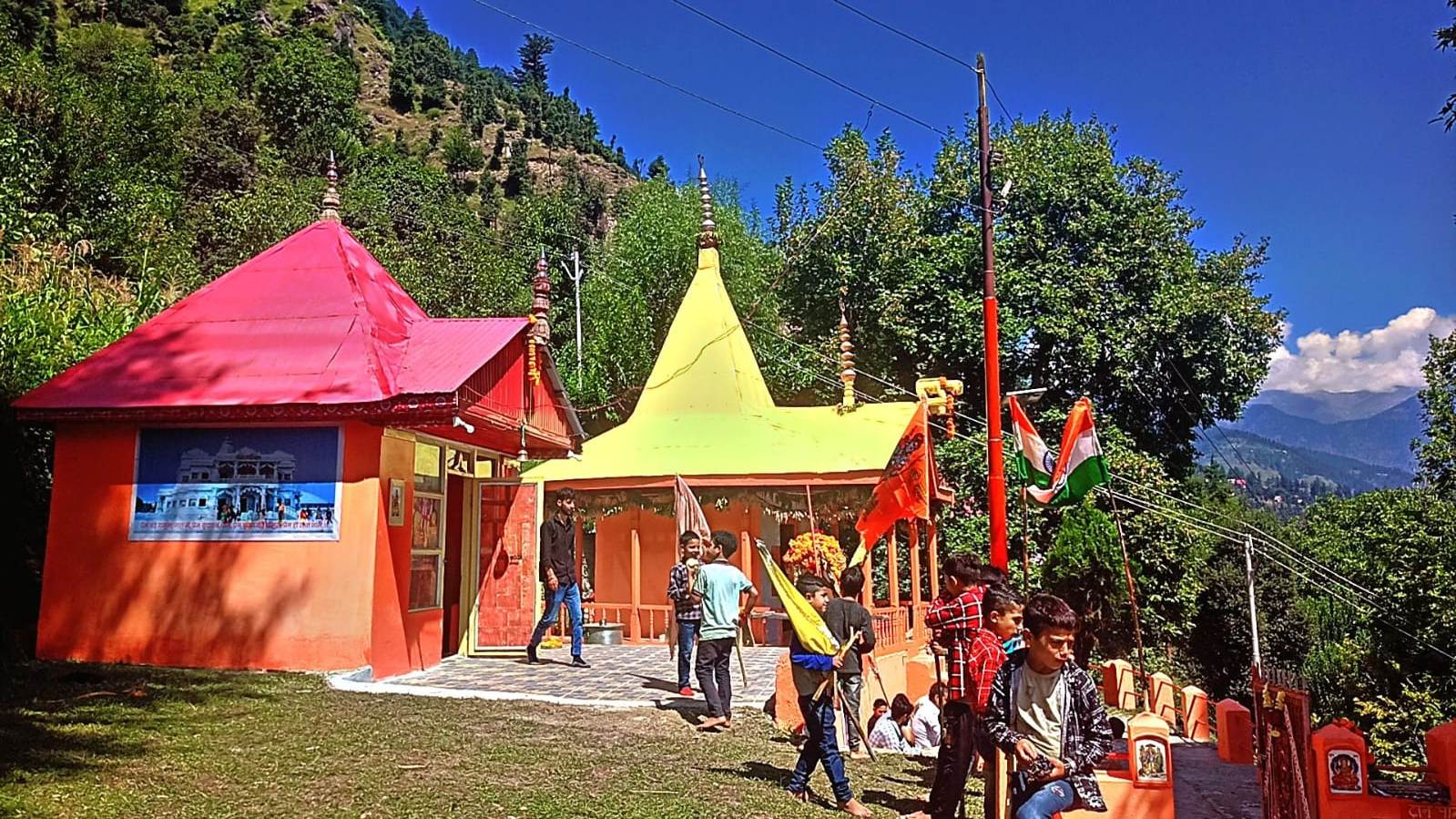
ANCIENT MANDIR AND ARCHEAOLOGICAL SITES AT DRUBEEL KISHTWAR
Drubeel, a village towards the North-west side of District Kishtwar and is almost 37 KM from the district headquarters. In this village, there is a majestic Densher Devta Mandir, a name that belies its rich history and cultural significance. Derived from the Sanskrit word “Udyensher”; it is combination of two words “Udyan” + “Eshwar”. This implies that the divine being associated with the sacred site possessed the extraordinary capability to transcend spatial boundaries, effortlessly soaring from one location to another. Steeped in legend, the Mandir is said to be the erstwhile domain of a serpent with the power of flight, bringing joy and wonder to all who beheld it. This ancient Mandir is also affectionately known as the Pandva Mandir, with local lore suggesting that the Mandir and its surroundings Baolies were painstakingly crafted by the Pandavas, the revered heroes of Jaisahintha (Mahabharata).
In accordance with local lore narrated by the renowned Master Sh. Chander Prakash ji, two brothers, Densher and Mehnsher are revered deities. The Mandir Densher is located in Drubeel village while his brother’s Mandir is situated at Khandol village in Horna Panchayat and is worshiped as Kuldevta of that area. In peculiar phenomenon prompted Mehnsher devta to manifest in the dreams of his Pujari (priest) instructing him to relocate wood from his Mandir to that of his brothers Mandir Densher devta, citing the intense sunlight that besieged the latter. The Pujari, however, discounted the dream which was soon followed by a catastrophic flood that swept the wood of that Mandir to a nereby stream. As the local residents endeavor to restore the wood to the original Mandir, the Pujari revealed that Mehnsher devta reiterated instruction to use the wood in construction of his brother’s Mandir. Then local inhabitants undertook a comprehensive renovation, transforming the Mandir into a magnificent and resplendent edifice. Local residents used to worship this Demigod from ancient times as their Kuldevta. Today in the main Mandir there is a Shivalinga in the middle and some wrecked statues are lying behind the Shivalinga. A leopard carved out of wood can be seen on the top of the roof of the Mandir. The ancient Shivalinga installed in this temple enhances its grandeur manifold. People from far and wide come here to fulfill their wishes. Along with the Shivalinga, there are some broken idols in the temple, which the local people have carefully preserved.
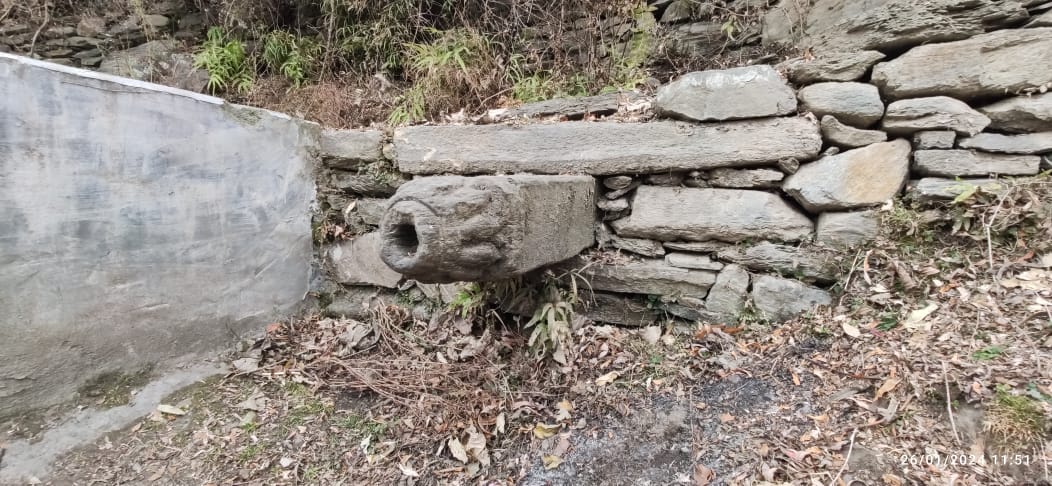
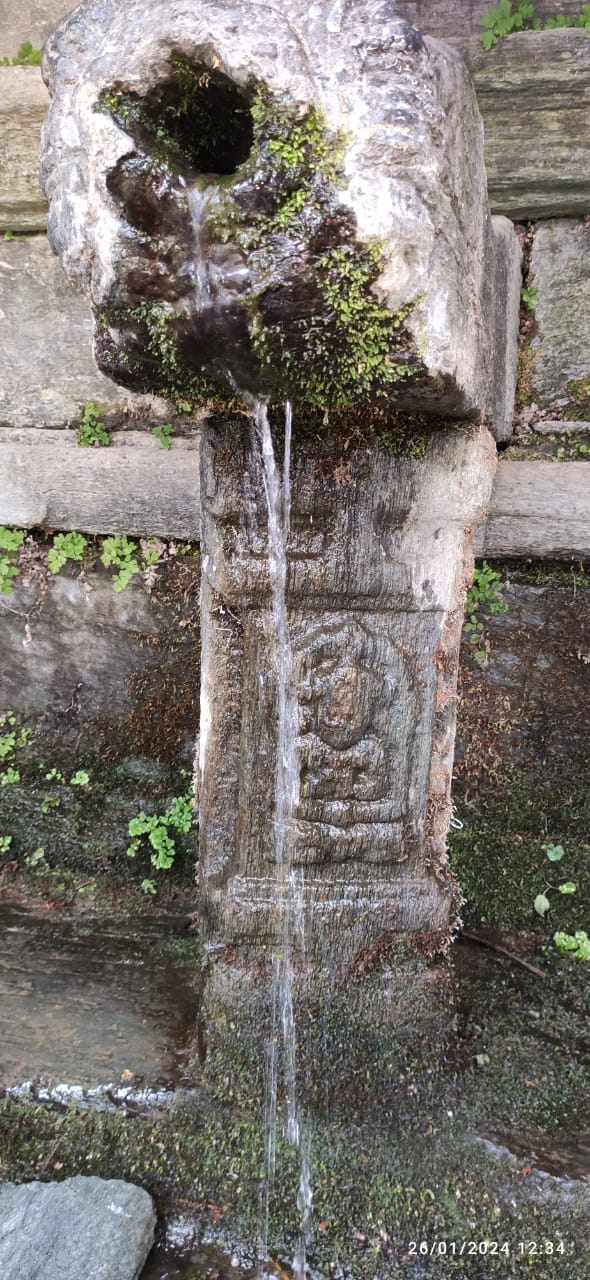

Beneath the Mandir are eight (08) Baolies on the south side of the Mandir and one Baolie is just below the Mandir with different dimensions. Each Baolie has a step well beneath the Baolie, but they are filed with mud giving the impression that they have not been cleaned from decades. There are six Noans lying in open giving the impression that either they were brought from elsewhere or their Baolies were destroyed naturally or by human actions, leaving these remnants behind.
The dimensions of these Baolies are as follows in feet:
| S.NO. | LENGTH | BREADTH | HEIGHT | COORDINATES |
| 1 | 10.6 | 06.7 | 7.00 | 33⁰22’08”N 75⁰40’09”E |
| 2 | 10.00 | 6.2 | 6.8 | 33⁰22’08”N 75⁰40’09”E |
| 3 | 09.10 | 6.3 | 6.6 | 33⁰22’08”N 75⁰40’09”E |
| 4 | 10.00 | 7.00 | 5.9 | 33⁰22’08”N 75⁰40’09”E |
| 5 | 7.7 | 5.9 | 4.5 | 33⁰22’08”N 75⁰40’09”E |
| 6 | 8.00 | 4.6 | 5.5 | 33⁰22’08”N 75⁰40’09”E |
| 7 | 7.00 | 4.00 | 5.9 | 33⁰22’08”N 75⁰40’09”E |
| 8 | 8.00 | 7.2 | 7.00 | 33⁰22’08”N 75⁰40’09”E |
Each Baolie has one Noan with different dimension. Details are as under:
| S.NO. | LENGTH | BREADTH | HEIGHT | COORDINATES |
| 1 | 2.10 | 0.10 | 0.9 | 33⁰22’08”N 75⁰40’09”E |
| 2 | 2.8 | 0.9 | 0.8 | 33⁰22’08”N 75⁰40’09”E |
| 3 | 2.11 | 1.0 | 0.7 | 33⁰22’08”N 75⁰40’09”E |
| 4 | 2.10 | 0.11 | 0.8 | 33⁰22’08”N 75⁰40’09”E |
| 5 | 1.8 | 1.6 | 1.3 | 33⁰22’08”N 75⁰40’09”E |
| 6 | 1.7 | 1.3 | 1.2 | 33⁰22’08”N 75⁰40’09”E |
| 7 | 1.6 | 1.8 | 1.0 | 33⁰22’08”N 75⁰40’09”E |
| 8 | 3.0 | 0.9 | 0.9 | 33⁰22’08”N 75⁰40’09”E |
The dimensions of the Noans are as follows:
| S.NO. | LENGTH | BREADTH | HEIGHT | COORDINATES |
| 1 | 2.10 | 0.10 | 0.9 | 33⁰22’08”N 75⁰40’09”E |
| 2 | 2.8 | 0.9 | 0.8 | 33⁰22’08”N 75⁰40’09”E |
| 3 | 2.11 | 1.00 | 0.7 | 33⁰22’08”N 75⁰40’09”E |
Upon exploring three Baolies, one discovers intricately carved stone figures, remarkably uniform in size and dimension. A trio of these carvings is situated at the base, while six more are positioned at the nave, seamlessly integrated into the wall. All these carvings depict figures in a meditative pose with their hands clasped in reverence.
The dimensions of the statues are as follows:
| S. NO. | LENGTH | BREDTH | HEIGHT |
| 1 | 2.2 | 0.11 | 0.2 |
| 2 | 2.1 | 0.9 | 0.5 |
| 3 | 2.0 | 0.10 | 0.5 |
Above the Noan there is also one statue in each Baolie and have the dimension as below:
| S. NO. | LENGTH | BREDTH | HEIGHT |
| 1 | 1.0 | —– | 1.00 |
| 2 | 2.1 | —– | 1.8 |
| 3 | 1.5 | —– | 1.8 |
Inside the first two baolies, the idols are installed in meditative postures. However, inside the third baolie, a leopards figure is carved out of stone is evident. Notably, its design is reminiscent of the wooden leopard carved at the top of main Mandir. Their dimensions are:
| S. NO. | LENGTH | BREDTH | HEIGHT |
| 1 | 1.8 | 0.8 | 1.3 |
| 2 | 1.4 | 0.5 | 1.5 |
| 3 | 1.6 | 0.3 | 1.2 |
Below the main Mandir on the south side there are three Baolies and the first Baolie has an eye catching carving in the front big stone. The carving is of two humans seems that one is adult and a child raising their hand towards the sky. The length X breadth of the adult carving is 0.55 x 0.6 inches and the diameters of the circles have 0.4 inches and 0.2 inches. A cursory examination of the Mandir and its surroundings reveals that the stones employed in the construction of these Baolies were likely sourced from nereby sites. Along with these Baolies, there is a stone with five Kunds carved into it, which the local people have kept protected.
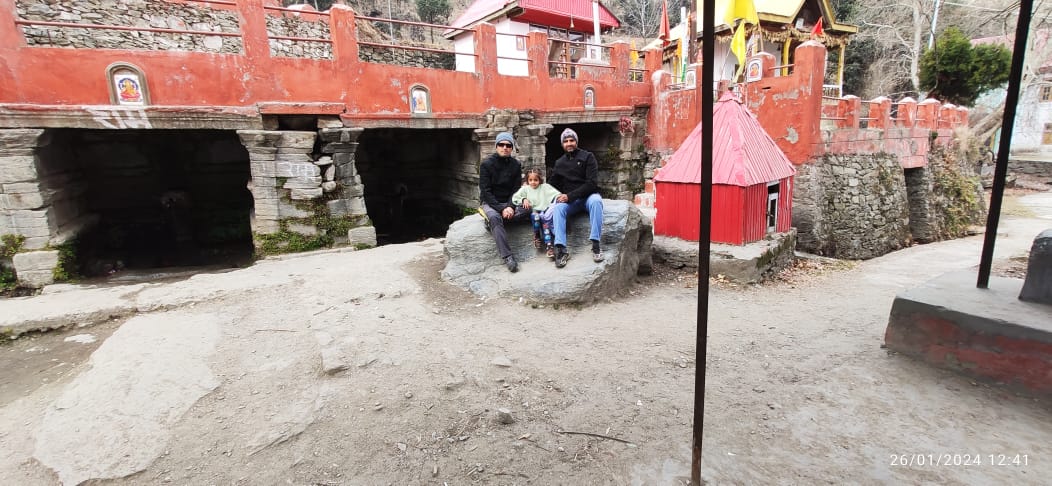
As I have repeatedly emphasized in my previous articles, I urge the local administration of Kishtwar and the inhabitants of that area to take concerted efforts to preserve, maintain, and clean these Baolies. Specifically, I implore the local residents to take ownership of safeguarding these Baolies at the grassroots level and ensure their cleanliness, as the water emanating from them is crucial for their daily lives. If we fail to pay attention to these Baolies, they may suffer the same fate as other Baolies, which have dried up and subsequently crumbled over time.
Authored by: ANIL KUMAR BHAGAT
Mobile: 7051350159
Email: anilk11111982@gmail.com
Disclaimer:This article presents the author’s personal research and interpretation of historical events. www.mykishtwar.com provides this platform for the dissemination of information and diverse perspectives. The accuracy, completeness, and validity of any statements made within this article are solely the responsibility of the author. The content of this article is the sole responsibility of the author. www.mykishtwar.com does not assume any liability for the information presented. The author’s views and opinions do not necessarily represent those of www.mykishtwar.com. Readers are encouraged to conduct their own research and verify the information presented.
Thankyou for sharing very important article on Dhansher Mandir Devta